
[Screen] Initial Image Build Screen
[Screen] Initial Image Build Screen

[Screen] Image Build Information
| Item (* is required) | Content |
|---|---|
| Image Name* | Specify what the image represents in detail (Note: Avoid the use of uppercase) |
| Registry* | Select the registry you created (If there are multiple registries, choose the applicable registry) |
| Use Auto Tag (Choose 1) | Indicate whether tags should be automatically set when updating or changing the image (Split into "Use/Do Not Use," and if "Do Not Use" is selected, the tag may be fixed, overwriting the existing image) |
| Tag* | Provide details for the tag to be attached to the created image (If "Do Not Use" is selected for auto-tagging, the tag entered here will be used consistently) |
| Auto-Increment Type (Choose 1) | If auto-tagging is set to "Use," it can be specified as "Time/Sequence" |
| Build Execution Server (Choose 1) | Select the server to perform the build |

[Screen] List of Build Jobs
| Item (* is required) | Content |
|---|---|
| Code Repository Work | Configure information to fetch source from git or similar sources |
| User Work | Configure information related to the build of the source fetched from git or similar sources |
| File (FTP) Work | Set up tasks to download or upload files or directories between the remote host and the build host where the build tasks are performed |
| Calling REST Work | If integration with external services is required using the REST method, configure REST call tasks |
| Script Work | Configure script information if a specific script is needed |
| Build Image Work* | Write a Dockerfile to apply the built source to a Base image and create a new image |

[Screen] Code Repository Operations
| Item (* is required) | content |
|---|---|
| Work Name* | Refers to the job stage for the image build, and enters a title for that job |
| Repository Address* | Enter the address for the Git or other source repository from which to import the source code. |
| Branch* | Enter the source branch applied to the repository |
| Authentication | When selecting the combo box for authentication, you must enter the user account and password required to access the git |
| Code Storage Path | Enter the directory to store the source (Automatically create git project name if not created) |

[Screen] Code Repository Operations After Writing, Click "Add a Build operation" Button

[Screen] User Task Execution Information for Maven Build
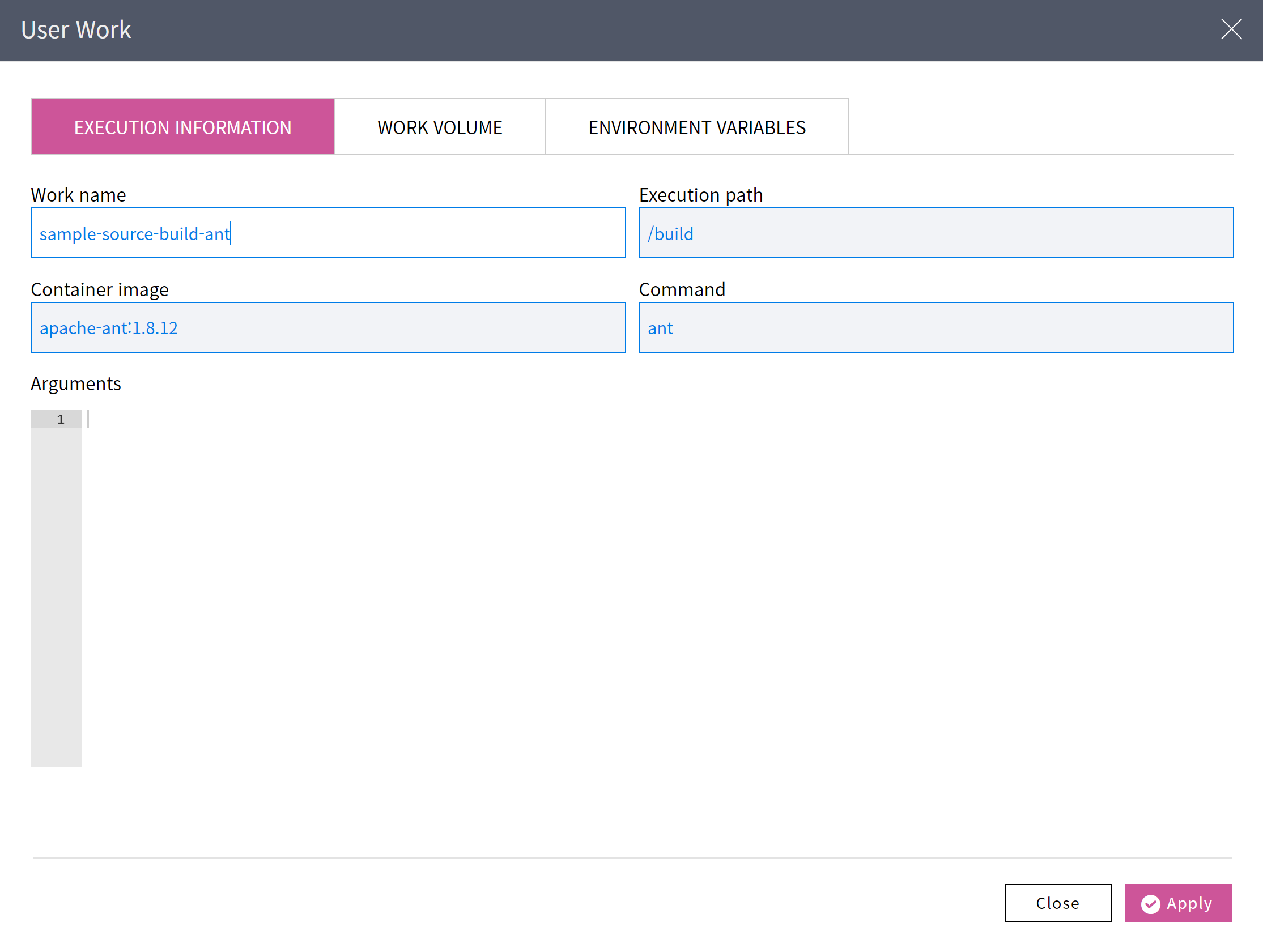
[Screen] User Task Execution Information during ant Build

[Screen] User Work WORK VOLUME
| Item (* is required) | Content |
|---|---|
| Container Path* | Write the path to the container where the source will be built |
| Build Host Path* | When building the source, a temporary container is created to proceed with the build. This is the path to the temporary container used during the source build |

[Screen] After writing the user Work, click the "Build image Work" button.

[Screen] Write Dockerfile
| Item (* is required) | Content |
|---|---|
| Work name* | Refers to the job stage for the image build, and enters a title for that job |
| enter docker file content* | Write a Dockerfile to create the actual container image |

[Screen] Completion of writing the build image work

[Screen] Build Image Creation Popup Window

[Screen] Run Build Image

[Screen] Build Image Execution Log

[Screen] build Image complete

[Screen] File (FTP) Work
| Item (* is required) | Content |
|---|---|
| Work name* | It refers to the operation stage for the file (FTP), and enter a title for that operation |
| Host address* | Server address with the directory or file that needs to be uploaded |
| Certification* | Need to set up if you have an account and password for the host address |
| User/Password* | Connection account and password for the host address |
| Task type (choose one) | File Download (If you want to include it in the image during image build, select this type) |
| Remote Directory/File* | Absolute path to the file to be uploaded to the image when building the image (Host address must have that file) |
| Build Host Directory* | Directory location to upload (/tmp/ fixed) |

[Screen] Calling REST Work
| Item (* is required) | Content |
|---|---|
| Work name* | Indicates the operation stage for a REST call, and enters a title for that operation |
| REST Method (choose one) | Choose the API call method |
| URL* | Write the URL for the API call |
| Certification | Configuration required if there is an account and password for the host address |
| User/Password | Username and password for the host address |
| Connection Timeout* | Write the response time for the API call |
| Expected response code* | Write the success code after the API call (ex] 200) |
| Expected response content | Must be left blank |
| Save the response to the build host path | Write the filename if response value storage is required (ex] response.txt) |

[Screen] Calling REST Work Screen - HEADER

[Screen] Script Work
| Item (* is required) | Content |
|---|---|
| Work name* | Define the steps for the image build process along with the corresponding work title. |
| Enter the script content* | Enter the content of the script to be executed. |